
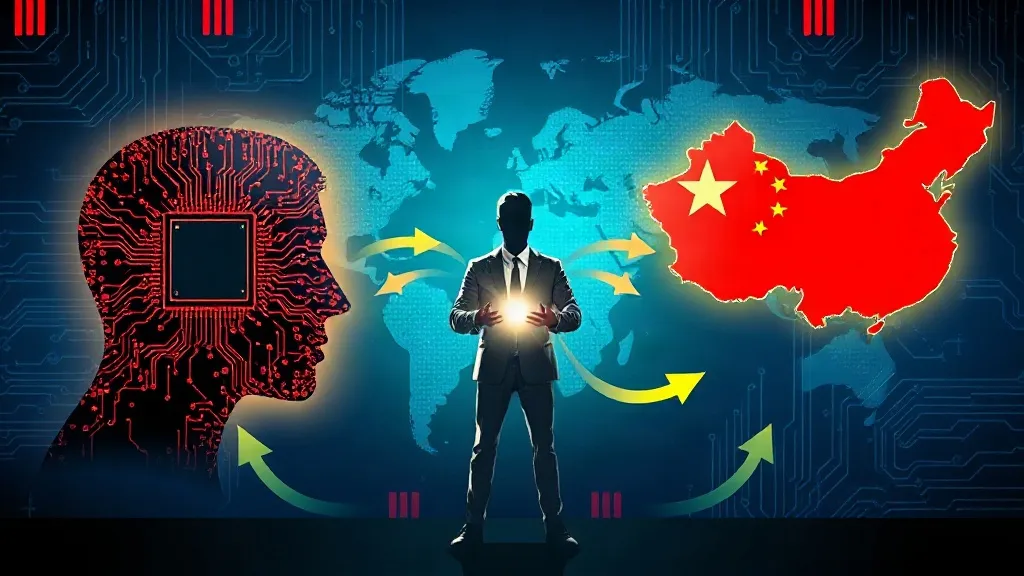
When Jensen Huang stepped back into the CEO role at Nvidia, it wasn't just a corporate comeback story. It was a signal that the U.S.-China artificial intelligence race has entered a new phase, one where the battles are fought not only in fabs and export controls but in the minds and talents of engineers, researchers, and leaders. Huang's return underscores a critical truth: the AI competition is about more than chips; it's about the human capital that designs, builds, and deploys them.
The Return of a Visionary Leader
Jensen Huang co-founded Nvidia in 1993 and has been the face of the company for most of its history. His departure and subsequent return might seem like a typical corporate shuffle, but in the context of the U.S.-China tech rivalry, it carries symbolic weight. Huang is not just any CEO; he is a visionary who has steered Nvidia from a graphics card maker to the backbone of the AI revolution. Under his leadership, Nvidia's GPUs became the de facto standard for training AI models, and the company's CUDA platform created a moat that rivals have struggled to cross.
Huang's return comes at a time when Nvidia faces unprecedented challenges. The U.S. government has imposed stringent export controls on advanced chips to China, limiting Nvidia's ability to sell its most powerful GPUs to Chinese customers. Meanwhile, China is pouring billions into its own semiconductor industry, aiming to reduce its dependence on American technology. In this environment, Huang's leadership is seen as crucial to navigating the treacherous waters of geopolitics and maintaining Nvidia's dominance.
The Talent Dimension of the AI Race
The U.S.-China AI race is often framed as a contest over hardware: who has the fastest chips, the most advanced fabs, the largest data centers. But Huang's return highlights the equally important dimension of talent. Nvidia's success is built on a deep bench of engineers and researchers, many of whom are immigrants from China and other countries. The free flow of talent has been a cornerstone of America's tech leadership, but recent policies and political tensions are putting that flow at risk.
China, on the other hand, is investing heavily in STEM education and has been successful in attracting top talent back home. The country produces more STEM graduates than any other nation, and its tech companies are increasingly able to offer competitive salaries and challenging work. This shift is gradually eroding the U.S. advantage in human capital, which could have long-term consequences for the AI race.
Huang himself is a testament to the power of talent. Born in Taiwan and educated in the U.S., he embodies the cross-border collaboration that has driven Silicon Valley's success. His return to Nvidia is a reminder that companies and countries that can attract and retain the best minds will lead the AI era.
Nvidia's Strategic Dilemma
Nvidia finds itself in a delicate position. On one hand, it must comply with U.S. export controls, which have already cost the company billions in potential revenue. On the other hand, it cannot afford to ignore the Chinese market, which is home to some of the world's largest AI companies and a growing base of customers. Huang's challenge is to strike a balance that satisfies regulators while keeping Nvidia's Chinese customers engaged.
One approach Nvidia has taken is to develop compliant chips for the Chinese market, such as the A800 and H800, which are tweaked versions of its flagship products to meet export restrictions. However, these efforts may not be enough as the U.S. continues to tighten rules. Huang's return could signal a more proactive strategy, perhaps involving closer collaboration with U.S. policymakers to shape regulations that protect national security without unduly harming American companies.
Another aspect is talent management. Nvidia has a significant research and development presence in China, and Huang will need to ensure that this talent is not cut off from the rest of the company. Maintaining a global R&D network in the face of decoupling is a complex task, but it is essential for staying at the cutting edge.
Implications for the Tech Industry
Huang's return and the broader U.S.-China AI race have implications that extend beyond Nvidia. For one, it signals that the tech industry is entering a period of heightened geopolitical risk. Companies that operate globally must now factor in export controls, talent mobility, and national security concerns into their strategic planning.
For startups and smaller players, the environment is particularly challenging. The AI race is capital-intensive, and access to advanced chips and top talent is increasingly restricted. This could lead to consolidation, with a few large players dominating the field. Alternatively, it could spur innovation in alternative approaches, such as chiplet designs or open-source AI models, that are less dependent on cutting-edge hardware.
For investors, Huang's return is a reminder that Nvidia's stock is not just a bet on technology but also on geopolitics. The company's valuation has soared on the back of AI demand, but any escalation in U.S.-China tensions could hit its bottom line. Investors would do well to monitor not only Nvidia's product roadmap but also the shifting policy landscape.
What to Watch in the Coming Months
As Huang settles back into the CEO role, several key developments will shape the narrative. First, Nvidia's ability to navigate export controls will be closely watched. Any new product announcements or partnerships in China will be scrutinized for compliance and strategic intent. Second, the company's talent retention efforts, especially in China, will indicate how well it can maintain its innovation engine. Third, Huang's engagement with policymakers in Washington will reveal whether Nvidia can influence the direction of AI regulation.
Beyond Nvidia, the broader U.S.-China AI race will continue to evolve. The U.S. is likely to maintain its lead in advanced chips and AI research, but China's progress in AI applications and its massive data advantage should not be underestimated. The country that can best harness talent and innovation will ultimately prevail.
Frequently Asked Questions
Why did Jensen Huang return as Nvidia CEO?
Jensen Huang returned to lead Nvidia through a critical period marked by geopolitical tensions, export controls, and fierce competition in AI. His deep understanding of the company and the industry positions him to navigate these challenges effectively.
How does the U.S.-China AI race involve talent?
The AI race is not just about hardware; it's about the engineers, researchers, and leaders who develop and apply AI technologies. The U.S. has historically benefited from attracting global talent, while China is increasingly investing in STEM education and retaining its own talent. The flow of talent between the two countries is a key factor in the competition.
What are the export controls affecting Nvidia?
The U.S. government has imposed export controls on advanced semiconductors to China, citing national security concerns. These controls restrict Nvidia from selling its most powerful GPUs to Chinese customers, forcing the company to develop compliant alternatives.
How is Nvidia responding to the challenges?
Nvidia is developing modified chips for the Chinese market that comply with export regulations. It is also investing in R&D and maintaining a global talent network to stay competitive. The company is likely to engage with policymakers to shape future regulations.
What does this mean for the future of AI development?
The U.S.-China AI race will likely accelerate innovation as both countries invest heavily in AI research and development. However, it may also lead to a bifurcated tech ecosystem, with separate standards and supply chains. Companies that can adapt to this new landscape will be best positioned for success.